General Description
Policy Summary:
Purpose:
- Define roles, responsibilities, and accountability for all parties involved in collecting, using, and disposing of data critical to Trinity University.
- Develop procedures, standards, and processes for effective governance of data.
- Ensure that the use of data complies with applicable laws, rules, and regulations.
- Ensure that data architecture is created and maintained in such a way that it is resilient, integrated, and meets Trinity’s future information needs.
- Ensure processes are in place to create and maintain data quality.
Scope:
Responsible Department:
- Academic Affairs
Policy Content
- Data has value as much as other assets such as buildings, vehicles, or money.
- Like other university assets, institutional data does not “belong” to individuals or units. Instead, it is managed by them on behalf of the university.
- Data shall be identified and defined so that its value can be leveraged and it can be managed appropriately.
- Data shall be appropriately managed (i.e., collected, stored, protected and used) throughout its life cycle.
- Data management shall be a core capability that is an integral part of the University’s culture.
- Named roles with specific responsibilities across the data lifecycle, from data entry to archive or disposal, should be defined, trained, and appropriately resourced.
- The single, master source for each different type of data shall be identified and data systems and integrations structured to rely on that source.
- Data shall be accurate and complete, at the appropriate quality for its primary purpose and all other known legitimate uses.
- Data shall be monitored so it can be trusted. Data stewards have the role of accountability and oversight to assure this trust, with decisions and actions recorded at an appropriate level of detail.
- Data access rules shall be clearly defined so that it can be made available where and when required, subject to appropriate security constraints.
- Standards will be consistently applied to encourage reuse, and promote a common understanding of context, meaning, and comparability.
- Data shall be easy to find, quick to understand, and simple to compare.
- Data shall be consistent and predictable, avoiding harm caused by conflicting versions.
- Data shall be protected against unwanted, or unauthorized access. Appropriate confidentiality shall be maintained.
- Data shall be acquired, used, stored and disposed of in compliance with the law and applicable standards, regulations and contractual obligations.
- Data integrity protects the university from reputational, financial, and regulatory damage.
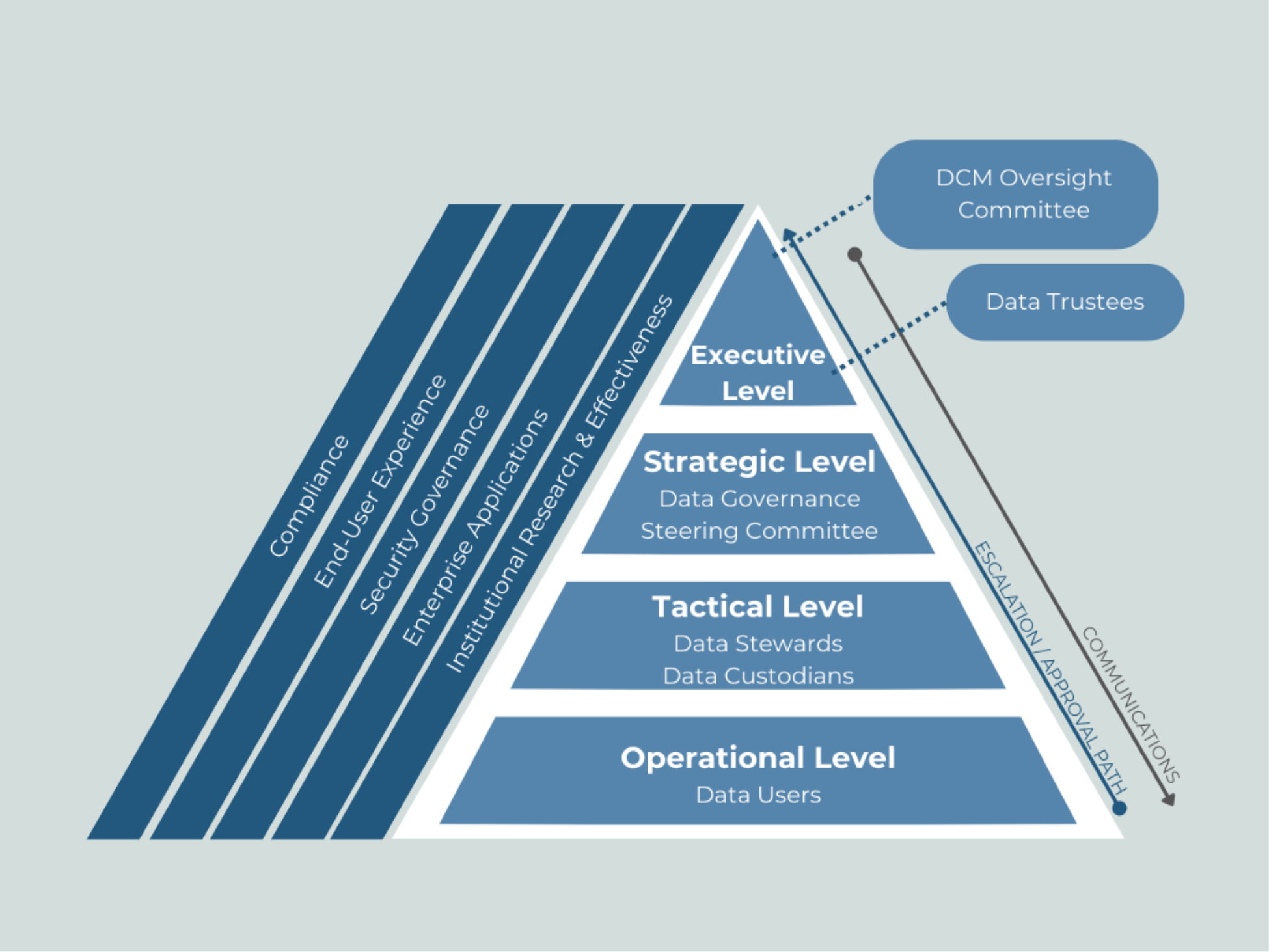
Click to expand
- Enterprise Applications
- Security Governance
- Data Governance
- End-User Experience
- Approving data governance strategy
- Approving data governance related documents such as a data role framework, data policies, and data governance priorities, methods, and tools
- Reporting on data governance activities to the CEO and Board of Trustees
- Providing resources for data quality remediation
- Collaborating with the Chief Information Officer to ensure that appropriate resources (staff, technical infrastructure, etc.) are available to support the data needs of the university
- Appointing a data steward for each domain/subdomain in their division
- Promoting data governance practices within their divisions
- Supporting cross-unit data governance priorities
- Developing data governance strategy
- Developing data governance related documents such as a data role framework, data policies, and data governance priorities, methods, and tools
- Overseeing the implementation and maintenance of the data governance strategy, policies, and tools
- Assigning each asset and system to the appropriate data domain
- Monitoring the effectiveness of the data governance framework
- Making recommendations for improvement to the data governance framework
- Sponsoring education and training for employees on data governance
- Reviewing Faculty Handbook language and suggesting revisions to the Faculty Senate to match policy recommendations
- Chairing the Data Governance Steering Committee and taking a lead role in accomplishing its responsibilities
- Developing methods for assessing the effectiveness of data governance practices, including data documentation, data quality, and compliance
- Serving on the Data Governance Steering Committee (data stewards of core domains only)
- Attending monthly Data Stewardship Committee Meetings or sending a delegate (depending on the domain, stewards of some functional domains are optional unless requested)
- Identifying Data Custodians for each of the domains or subdomains for which they are responsible
- Recommending policies to the Data Governance Steering Committee and providing feedback on draft policies
- Establishing procedures and guidelines to implement data governance policies (concerning data access, completeness, accuracy, privacy, and integrity) for the domains or subdomains for which they are responsible
- Performing periodic reviews to ensure continued compliance with data protection and classification policies and all other university policies that pertain to data in the domains or subdomains to which they are assigned
- Defining who can access and use data in the domains or subdomains to which they are assigned, including reviewing restricted data usage and use requests
- Determining legal and regulatory requirements for data in their areas, in collaboration with the Chief Compliance Officer
- Developing, implementing, and communicating record retention requirements
- Ensuring that individuals with visibility into protected data have completed required training and have signed confidentiality agreements
- Creating a data catalog of the assets/systems under their purview and data dictionaries describing what is in them
- Documenting metadata, including the source of data assets and their contents
- Identifying critical data elements (CDEs)
- Creating a business glossary of business definitions for CDEs
- Defining the data quality rules for each CDE
- Enabling CDEs for data quality monitoring (i.e., creating methods for ensuring that CDEs are high quality across all data quality dimensions)
- Identifying data quality issues and creating plans to address them
- Publishing data quality KPIs and data quality remediation scorecards to the Steering Committee
- Following the procedures and guidelines established by Data Stewards to implement data governance policies
- Monitoring data quality
- Supporting users in understanding and using data correctly
- Provisioning, modifying, and deprovisioning least-privilege, role-based access to systems and applications as authorized by the Data Steward, if applicable, and logging/monitoring access to restricted/confidential data
- Requesting data user access through ITSupport@trinity.edu or the appropriate system administrator
- Notifying Human Resources of employee rights changes and/or terminations
- Completing role-specific training to enhance data literacy and acceptable data use
- Ensuring that ITS and relevant Data Stewards are promptly notified of employee or contractor terminations, department transfers, and pending terminations
- Determining sanctions for policy violations
Terms & Definitions
Terms and Definitions:
|
Term: |
Definition: |
|---|---|
| Data Governance |
Data governance is the practice of formalizing behavior around the availability, usability, integrity, and security of data. It includes establishing roles and responsibilities for data access, definition, and quality to enable Trinity to use data effectively while ensuring security and confidentiality. |
| Data |
Data is a collection of facts, numbers, words, observations, or other useful information. It can be structured (i.e., organized in a clear, predefined format) like data tables with rows and columns or unstructured (i.e., not organized in a predefined format) like PDFs of transcripts stored in folders. |
| Data Lifecycle |
A data lifecycle represents all the life stages of data, including collecting/creating, storing/maintaining, using/processing, sharing/disseminating, and archiving, and/or destroying/purging data. |
| Data Domain |
A data domain is a broad category of data that is managed as a group. Each data domain includes related types of data that are tied to a business function. |
| Data Subdomain |
Data subdomains are smaller, more specific categories within a data domain. These subdomains represent finer divisions of data that correspond to particular business processes or areas of activity within the broader domain. |
| Core Domain |
Core domains impact multiple functional areas, are important for institution-level planning, use shared resources, and are essential for ensuring consistency and integration across systems. |
| Functional Domain |
Functional domains are more localized than core domains both in their management and in their impact. |
| Data Catalog |
An inventory of Trinity’s data assets that provides an overview of all available data. Helps data users find the data they need. |
| Data Dictionary |
Defines the data in a data asset. Includes information about how to describe or manage data, rather than the data itself. Helps users understand the types of data in a data asset and their meaning. |
| Business Glossary |
A glossary of business definitions (see below) to help users understand Trinity’s Critical Data Elements (see below) |
| Business Definition |
A clear and concise description of a data element that helps drive understanding of the meaning of data. |
| Critical Data Element (CDE) |
Data that informs and enables Trinity's operations, decision-making processes, risk management, reporting accuracy, and compliance with regulatory requirements. |
| Data Quality |
Describes the accuracy, completeness, consistency, validity, timeliness, uniqueness, and integrity of data (see below). |
| Metadata |
Data that describes information about other data, including business metadata, operational metadata, and technical metadata. |
| Business Metadata |
Metadata that connects data domains to data stewards, drives business data definitions, and supports compliance by connecting data with security classifications, retention policies, and data regulations. |
| Operational Metadata |
Metadata that contains information about how and when the data was created or transformed. It may include information such as time stamps, location, or job execution logs. |
| Technical Metadata |
Metadata that shows where data came from in terms of the physical databases, systems, and data flows across the institution. Technical metadata also describes data structure, storage, format, and processing. This type of metadata usually includes information such as data types, column names, and table structures. |
| Accuracy | Free from error; reflects reality |
| Completeness | Includes all necessary parts; no missing information |
| Consistency | Aligns with other data as expected |
| Validity | Conforms to predetermined format and constraints |
| Timeliness | Current; available when needed |
| Uniqueness | Unique; no duplication in records |
Related Documents
Related Content:
Federal Data Regulations
Family Educational Rights and Privacy Act (FERPA)
Health Insurance Portability and Accountability Act (HIPAA)
International Data Regulations
General Data Protection Regulation (GDPR)
Revision Management
Revision History Log:
|
Revision #: |
Date: |
Recorded By: |
|---|---|---|
| v1 | 7/27/2026 1:41 PM | Pamela Mota |
Vice President Approval:
|
Name: |
Title: |
|---|---|
| Megan Mustain | Provost and Vice President for Academic Affairs |